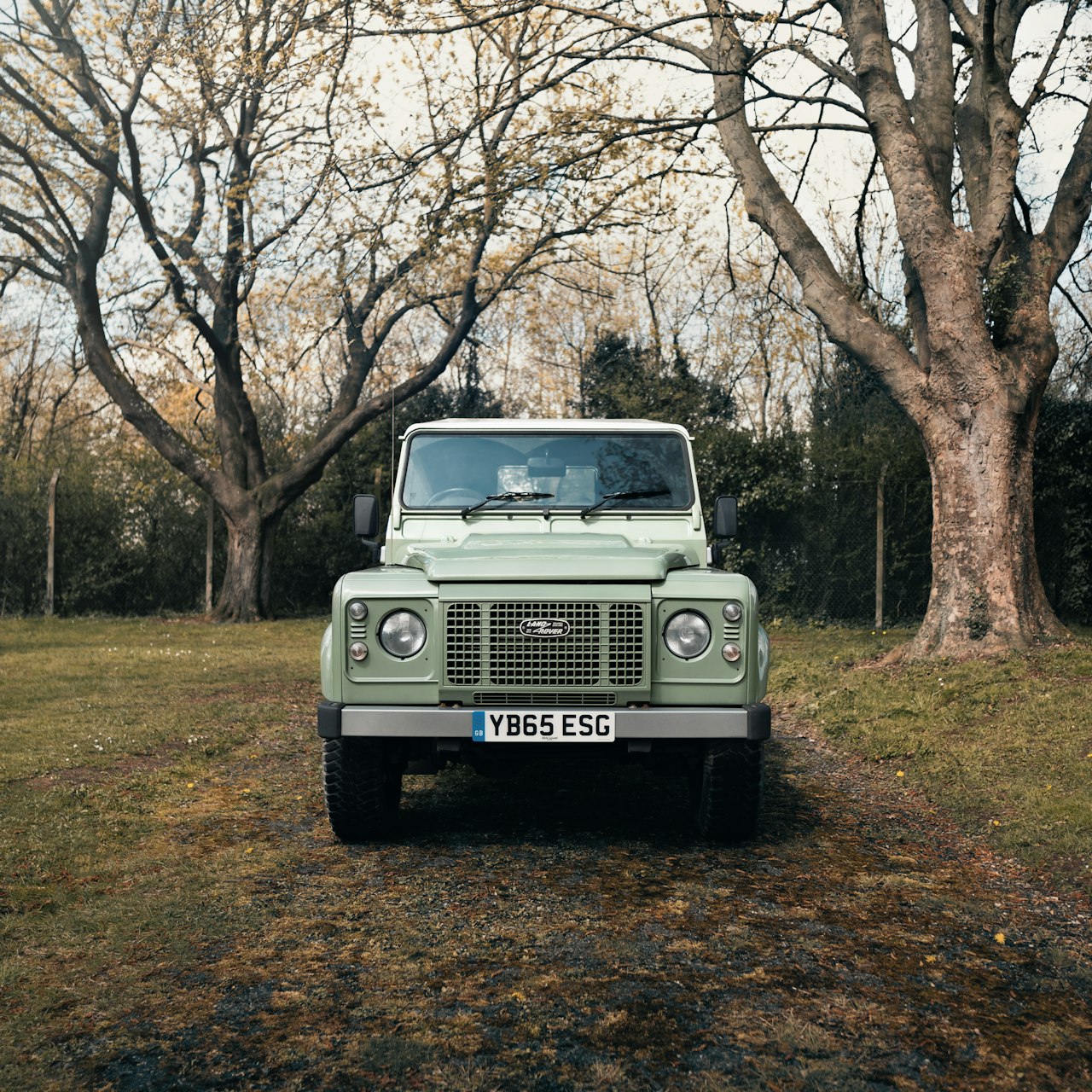
The Marque
“A vehicle so honest, it became a legend.”
The character that seven decades of production could not diluteThe Land Rover story begins in 1948, when Rover engineer Maurice Wilks sketched a utility vehicle concept using a stick in the sand of a Welsh beach, inspired by the wartime Jeep on his farm. The result — built on a surplus Jeep chassis with an aluminium body to sidestep post-war steel rationing — was intended as a stopgap product to keep the Rover factory busy while the company rebuilt. The Series I, launched at the Amsterdam Motor Show in April 1948, outsold every other Rover product within a year. The stopgap became the franchise.
What followed was seven decades of deliberate evolutionary development rather than revolution. The Series II arrived in 1958 with a wider body and the 2.25-litre engine. The Series IIA in 1961 added a diesel option. The Series III in 1971 brought a fully synchromesh gearbox and a revised dashboard. The Defender — initially the 90 and 110 — launched in 1983 with coil spring suspension and eventually the 200Tdi turbodiesel that transformed the driving experience. The last Defender left the Solihull production line in January 2016. The total number built across all Series and Defender variants runs to well over two million.
The aluminium body panels on a separate steel chassis were not a compromise — they were the right engineering choice. The aluminium does not rust. The steel chassis does, particularly where it carries mud in the outriggers and crossmembers, and particularly where the body panels make contact with the steel structure and create galvanic corrosion cells. Understanding this dynamic is the foundation of any Series or Defender restoration. The bodywork survives; the structure beneath it is the fight.
The global owner community is one of the most active in the classic vehicle world. Parts supply from commercial specialists has remained economically viable for decades because the vehicles were built in such numbers, because the design is simple enough to support, and because owners genuinely drive them. A well-maintained Series III or Defender 110 is not a museum piece. It is a working vehicle — and one that, with the right attention, will outlast almost anything else on the road.
Can’t identify the part you need? Describe it in plain English, upload a photo, or paste a part number. CarSpanner identifies Land Rover components from Series I/II/III cross-references, military spec variants, and part number stampings — and cross-references against the specialist suppliers most likely to stock it. Find a Land Rover Part →
Model History
Five major generations. Know which chassis you have before ordering anything structural — specifications diverge significantly between Series variants, and Defender architecture is a different proposition entirely.
The original. 80-inch wheelbase initially, extended to 86 and 107 inches by 1956. Aluminium body panels over a separate steel chassis. The 1.6-litre Rover petrol engine was replaced by the 2.0-litre unit in 1952. Free-wheeling front hubs as standard, centre-mounted PTO for agricultural implements. The Series I has a dedicated specialist following — Craddock's and the Series One Club are the primary resources. Parts availability is thinner than later models but the basics remain findable. High interchangeability between the 1952–1958 2.0-litre engine and the later 2.25-litre is a practical advantage for restorers.
The Series II (1958) brought a wider body, the 2.25-litre petrol engine, and improved weather sealing. The 88-inch and 109-inch wheelbases became the standard short and long-wheelbase configuration. The Series IIA (1961) added a factory diesel option — the 2.25-litre diesel — and the 2.6-litre six-cylinder engine on the 109-inch Station Wagon. Forward Control variants are a specialist pursuit. Parts interchangeability with the Series III is high on mechanical components. The IIA bulkhead and chassis corrosion patterns are identical to the Series III; approach with the same rigour.
The most numerous of the Series vehicles — over 440,000 built. Revised plastic-faced dashboard replacing the earlier metal unit, fully synchromesh gearbox on petrol models, and minor refinement throughout. The same 2.25-litre petrol and diesel engines continued. A 3.5-litre V8 petrol option became available on the 109-inch from 1979. The Series III is the most logical starting point for a first Land Rover restoration: parts supply is the widest, the community knowledge is deepest, and the mechanical architecture is straightforward. Chassis outrigger and bulkhead footwell corrosion are universal problems. Galvanised replacement chassis are available.
The 90 and 110 launched in 1983 as the Series III replacement, initially carrying the 2.25 petrol and diesel engines. The 3.5-litre V8 was the prestige option. The 200Tdi turbodiesel arrived in 1990 and immediately became the definitive Defender powertrain — torquey, economical, and transformatively better than any petrol option in the field. The 300Tdi followed in 1994 with more power, more refinement, and a known weakness in the external oil cooler pipes. Coil springs replaced leaf springs at the front on Defender, dramatically improving ride and handling over the Series. The Defender 130 (130-inch wheelbase) joined the range for commercial applications.
The Td5 (1998–2006) introduced electronic fuel injection for the first time in a Defender, requiring a different diagnostic approach from all predecessors. The engine itself is strong; the known weak point is the injector loom harness, which degrades and causes injector seal failures. Maintain the harness on schedule. The Puma-engined Defender (2007–2016) used a Ford-derived 2.4-litre Duratorq diesel, later replaced by a 2.2-litre unit. Common rail injection, significantly more refined than any previous Defender. The Puma is the most powerful and polished production Defender ever made. Electronic complexity increases with each generation — factor in diagnostic equipment for Td5 and Puma ownership.
Common Parts Challenges
Land Rover parts supply is among the best-supported in the classic off-road world. The volume produced, the simplicity of the architecture, and the global community have kept commercial suppliers viable for decades. Here is what to expect by category.
Body: Galvanic Corrosion and Aluminium-to-Steel Contact
The aluminium outer body panels do not rust — but the steel structure they bolt to does, and the contact between the two metals creates galvanic corrosion cells that accelerate the steel's deterioration wherever the two materials touch. Door skins are aluminium and survive well; the steel door frames behind them rot at the lower corners. Wing panels are aluminium and broadly survive; the steel A-pillars and sill structure beneath them corrode from the inside. The rear tub panels are aluminium; the steel crossmembers and body mounting points corrode beneath them. The standard repair protocol: treat and seal all steel surfaces before refitting aluminium panels, and use neoprene or felt washers at contact points. New aluminium replacement panels for doors, wings, rear tub sections, and bonnets are available from Paddock Spares, Rimmer Bros, and Britpart.
Chassis: The Number One Killer
The separate ladder chassis is the structural heart of every Series and Defender. Chassis corrosion is the primary cause of uneconomic write-offs on otherwise restorable vehicles. The chassis rails themselves rot from the inside out — water and mud enter through drainage holes and drain plug apertures and cannot escape. The outriggers — the transverse members that carry the body mounting points — rot in the mud traps formed where they meet the main rails. The rear crossmember corrodes universally on unrestored vehicles. The correct assessment before any purchase: probe every outrigger with a screwdriver, check the inner face of the main rails, and tap along the crossmember. Good metal does not give. Rotten metal is soft and will deform under probe pressure.
Replacement chassis options: standard painted mild steel (cheaper, same material as original, will need further attention within 10–15 years); galvanised from Richards Chassis or Marsland Engineering (significantly more expensive, will outlast the body of the vehicle, the definitive long-term solution). The debate in the community is not whether galvanised is better — it clearly is — but whether the budget allows it. If you are replacing the chassis, the galvanised option is almost always the right decision.
Engine: 2.25 Petrol and Diesel (Series)
The 2.25-litre four-cylinder engine fitted to Series II, IIA, and III is exceptionally well supported. Rebuild kits including pistons, liners, bearings, timing components, and full gasket sets are available from Paddock Spares, Rimmer Bros, and Britpart. The engine is designed to be rebuilt by a competent amateur with the correct workshop manual. Head gasket failures are the most common single fault on overheated or coolant-neglected units. Camshaft wear is a known issue on high-mileage petrol units — check lobe condition at any rebuild. The diesel variant shares the same block architecture and many components. Both versions benefit from oil changes at 3,000-mile intervals rather than the factory recommendation.
Engine: 200Tdi and 300Tdi (Defender)
Both Tdi engines are well supported by Paddock, Rimmer Bros, Bearmach, and Britpart. The 200Tdi timing belt and tensioner are the primary scheduled maintenance item — interval adherence is not optional. The 300Tdi external oil cooler pipes are the known weak point: the pipes crack and weep oil over time, causing mess and — if ignored — potential overheating. Inspect at every service; replace proactively rather than reactively. Head gasket failure on both engines is the consequence of overheating, incorrect coolant specification, or neglected service intervals. Use silicate-free coolant on Tdi engines; standard green antifreeze degrades the water pump seal. A correctly maintained 200Tdi or 300Tdi will exceed 200,000 miles without major internal work.
Transmission: Transfer Box, Gearbox, Overdrive
The LT77 gearbox used on early Defenders and the R380 on later models are both robust units when maintained with the correct oil specification. LT77 synchromesh on second gear is the most commonly reported wear item. Transfer box selectors and high/low ratio forks wear on neglected examples. Rebuild kits for both units are available from Paddock and Rimmer Bros. For Series vehicles, Fairey and Superwinch overdrive units were popular aftermarket additions to improve motorway cruising on 2.25 engines — spares for both are still findable, though increasingly scarce for the Fairey. Gearbox oil leaks on transfer boxes are universal on unrestored vehicles; address input and output seals before they cause bearing damage.
Electrical: Lucas (Series) and Later Systems
Series Land Rovers use the Lucas electrical system. Early Series I and II models are positive-earth — a detail that matters if you are fitting any modern electrical accessory. Series III switched to negative earth. The system is simple enough to be traced with a multimeter and a workshop wiring diagram. Problems arise almost exclusively from previous owners who bypassed faults, fitted accessories incorrectly, or allowed connections to corrode. The solution is methodical: trace every circuit from scratch with the correct diagram for your specific chassis year. Full wiring loom replacements are available from Autosparks and from Paddock Spares. The Defender Td5 electrical system is more complex and requires a Testbook or equivalent diagnostic system for injector and ECU faults.
Interior: Seats, Dashboard, Hood Sticks and Canvas
Series interior parts availability is reasonable for the most commonly replaced items. Seat base frames corrode and the cushions compress over decades — replacement seat base assemblies and cushion sets are available from Paddock and Exmoor Trim. Dashboard fascias for Series III (the plastic-faced unit) are available new. Series I and II metal dashboards are harder to source new but found in good condition through club spares schemes. Hood (soft top) stick sets and canvas are available from Exmoor Trim and Paddock Spares, in both pattern and heavy-duty specifications. Defender interior trim — seat trim kits, carpet sets, door cards — is comprehensively supported by Rimmer Bros and Paddock.
Axles: Swivel Balls, Half Shafts, Differentials
The front axle swivel ball housing is the most frequently serviced item on any Series or Defender. The swivel balls — large ball joints on which the steering knuckles pivot — wear and develop play, causing shimmy and imprecise steering. Swivel ball kit replacement (swivel ball, housing gasket, seal kit, and preload shims) is standard scheduled maintenance every 30,000 miles or whenever play is detected. Half shafts are a known failure point on Series vehicles that have been used for heavy off-road work — uprated half shafts from Ashcroft Transmissions are widely fitted by owners who use their vehicles hard. Differential rebuilds (crown wheel, pinion, and bearings) are within the scope of a methodical workshop with the correct tools. Wheel bearings across the front and rear axles are standard maintenance items available from all suppliers; use Bearmach or OEM rather than pattern parts.
Series vs Defender Buying Guide
Series and Defender are the same philosophy in different engineering generations. Which one you buy determines which problems you are signing up for.
Series: Simplicity as a Feature
A Series Land Rover is mechanically transparent in a way that almost no other vehicle is. The engine, gearbox, and axles can be understood, diagnosed, and repaired with basic tools and a Haynes or Brooklands workshop manual. There is no electronic management system to confound diagnosis. There are no complex suspension geometries requiring specialist alignment equipment. The chassis can be inspected visually and repaired by fabrication. For an owner who wants to understand and maintain their own vehicle, the Series is the correct choice. The trade-off is that an unrestored Series will be genuinely agricultural to drive by modern standards — slow, loud, and requiring consistent physical input.
Series to Series: What Interchanges
The 2.25-litre engine is the same unit across Series IIA and Series III in both petrol and diesel guise — short blocks, cylinder heads, and most ancillaries are interchangeable. Front and rear axle housings carry over. The Series III fully synchromesh gearbox does not directly interchange with the Series IIA crash-first unit. Body panels are wheelbase-specific (88-inch and 109-inch parts differ), but the mounting arrangements are consistent. The Series III LT95 four-speed gearbox and transfer box is a popular upgrade for Series IIA owners seeking synchromesh on all gears. Most electrical components from Lucas — switches, relays, control boxes — are common across Series II and III.
Defender: More Capable, More Complex
The Defender offers coil spring suspension (dramatically better ride and articulation than the Series leaf spring arrangement), a choice of far more powerful and economical engines, and a more refined driving environment. The Defender 90 and 110 are genuine dual-purpose vehicles — usable as daily transport in a way a Series is not. The trade-off is greater complexity: the coil spring geometry requires specific alignment, the Tdi and later engines need proper diagnostic tooling, and the Td5 electrical system requires Testbook or equivalent. The Defender's parts supply is excellent but increasingly expensive as values rise. A good Defender 110 300Tdi is one of the most capable and practical classics available at any price point.
The 200Tdi Into Series Conversion
The most popular engine conversion in the Series community: fitting a Land Rover 200Tdi turbodiesel into a Series III (or II) body. The result is a vehicle with three to four times the torque of the original 2.25 diesel, dramatically better fuel economy, and a performance level compatible with modern traffic. The conversion requires the Tdi engine, an LT77 gearbox and matching bellhousing (the Series LT76 does not mate to the Tdi), motor mount fabrication or a proprietary kit, a cooling system upgrade, and a compatible fuel system. Detailed conversion guides are maintained by the LR4x4 forum and the Series One Club technical archives. The 200Tdi is preferred over the 300Tdi for this conversion because it is slightly shorter and fits more naturally in the Series engine bay. A properly executed 200Tdi conversion transforms the Series as a usable vehicle without compromising its essential character.
OEM vs Reproduction
The Land Rover parts reproduction market is mature and extensive. The choice between Genuine Land Rover, Bearmach, and pattern parts is one every restorer faces. Here is how to navigate it.
The Quality Hierarchy
Genuine Land Rover (OEM) is the benchmark. For safety-critical components, it is the correct choice. Bearmach occupies the tier below — generally OEM-equivalent quality, widely used by professional workshops, acceptable for most mechanical components. Britpart is the most widely available but quality-variable brand; excellent for some applications, genuinely dangerous for others. Pattern parts from various unbranded sources vary from acceptable to seriously substandard. Paddock Spares own-brand parts are typically Bearmach or OEM-sourced. Rimmer Bros stock is similarly cross-sourced and generally reliable.
Never Pattern: Brake and Steering Components
This is the rule with no exceptions: never fit unbranded or Britpart brake components, wheel bearings, or steering joints to a vehicle used on the road. Britpart brake discs, pads, and wheel bearings have documented quality failures in the owner community. The consequences of a brake disc cracking or a wheel bearing collapsing are serious. For every safety-critical item — brake discs, pads, calipers, master cylinders, wheel bearings, swivel ball kits, track rod ends, steering relay joints — use Genuine Land Rover, Bearmach, or Allmakes only. The cost difference between Bearmach and Britpart on these components is small; the risk difference is not.
Aluminium Body Panels: Second-Hand is Often Better
Unlike steel body panels, aluminium Land Rover body panels do not rust. A good second-hand aluminium wing, door, or bonnet is often preferable to a cheap new reproduction with fitment issues. Inspect used panels for stress cracks around mounting points, accident damage, and impact deformation — if straight and undamaged, a used panel is functionally equivalent to new. Dunsfold Land Rover and club classifieds carry reliable second-hand aluminium stock. For new aluminium panels where fitment accuracy matters, Paddock Spares and Rimmer Bros are the first choices.
Gaskets, Seals, and Consumables: Britpart is Acceptable
For non-safety consumables — sump plug washers, rocker cover gaskets, minor seals, body fixings, and similar items — Britpart quality is generally acceptable. These are applications where the consequence of a part failing is minor inconvenience rather than safety risk. The practical approach: use OEM or Bearmach for anything that moves, loads, stops, or steers the vehicle; use Britpart or pattern for static sealing and body fixings where the risk profile is low.
Supplier Quick Reference
These are the suppliers Land Rover owners consistently rely on. Rimmer Bros and Paddock Spares are the natural first stops for UK buyers; Atlantic British serves North America.
| Supplier | Location | Strengths | Best For |
|---|---|---|---|
| Rimmer Bros Affiliate · Primary UK | Lincolnshire, UK | Comprehensive Land Rover catalogue covering Series I through Defender Td5. Strong on body panels, mechanical, electrical, and trim. Worldwide shipping. Well-indexed online catalogue with part number search. | First stop for most Land Rover parts. Particularly strong on Defender mechanical components, body panels, and electrical items. Affiliate partner — competitive pricing with good stock levels. |
| Paddock Spares Primary UK | Chesterfield, UK | Largest UK Land Rover specialist by catalogue breadth. Comprehensive stock across Series I through Defender. Competitive pricing on mechanical and body parts. Strong technical catalogue cross-referencing. | Series II and III mechanical components, chassis sections, and body panels. Strong for 200Tdi and 300Tdi Defender parts. Good alternative to Rimmer Bros when stock availability differs. |
| Britpart Wide Range | UK | Extremely wide catalogue across the full Land Rover range. Competitive pricing. Available through most UK specialists. Quality is variable — acceptable for non-safety items. | Non-safety consumables: body fixings, minor gaskets, trim clips, and similar items where quality risk is low. Do not use for brake components, wheel bearings, or steering joints. |
| Bearmach OEM Quality | UK | Quality Land Rover parts brand, generally regarded as OEM-equivalent. Used widely by professional workshops. Strong on safety-critical mechanical items. Available through Rimmer Bros and Paddock. | Safety-critical items: brake components, wheel bearings, swivel ball kits, steering joints, and suspension components. The correct quality tier below OEM for components where failure matters. |
| Craddock’s Series Specialist | UK | Dedicated Series Land Rover specialist with deep stock of harder-to-find Series I and early Series II components. Trusted by the dedicated Series restoring community. | Series I and early Series II specific parts. Specialist items not stocked by the large generalists. The first call for Series I owners when Paddock and Rimmer Bros are out of stock. |
| Richards Chassis Chassis Specialist | UK | Manufactures galvanised replacement chassis for Series and Defender. Industry reference for long-life chassis solutions. Also galvanised outriggers, crossmembers, and body mounts. | Any chassis replacement. The correct choice when you want to do the chassis work once. Also individual galvanised outriggers for partial chassis restoration. |
| eBay General Marketplace | Global | Extensive NOS (new old stock) and used parts available at auction and fixed prices. Useful for electrical components, trim items, and smaller mechanical parts that are hard to find commercially. | NOS and used parts searches. Search by Land Rover part number for best results. Particularly useful for Series I and early Series II items that commercial suppliers no longer stock. Inspect carefully before purchase. |
| Demon Tweeks Affiliate · Performance | UK (Wrexham) | Performance and uprated parts specialist. Stocks Old Man Emu, Terrafirma, and other suspension upgrade brands for Defender. Good source for uprated shock absorbers, springs, and off-road accessories. | Defender suspension upgrades and performance accessories. If you are uprating beyond OEM specification, Demon Tweeks carries the brands that serious off-roaders trust. |
| Atlantic British Primary US | Vermont, USA | Leading North American Land Rover specialist. Strong stock across Series I through Defender. US-friendly shipping and service. Well-regarded catalogue quality. | North American buyers. Series and Defender mechanical components. Strong on Defender 90/110 parts for the US market where left-hand drive variants were officially imported. |
For any Land Rover part where you are unsure of the correct specification for your chassis year and wheelbase, ask CarSpanner. Describe the vehicle, the wheelbase, the engine specification, and the component needed — we will identify the correct part number and the best current source.
Community Resources
The Land Rover community is one of the most organised and technically thorough in the classic vehicle world. These are not merely enthusiast forums — they maintain technical archives, spares schemes, and collective knowledge that supplements and in some areas exceeds what any commercial supplier can provide.
Land Rover Series One Club
The dedicated club for Series I owners, with a particular focus on the 1948–1958 vehicles that have the thinnest commercial parts support. The Series One Club maintains a comprehensive spares register, a technical archive covering every aspect of the 80-inch and later Series I specification, and a community of owners who between them have encountered every problem these vehicles present. For a Series I owner, this club is the primary technical resource — more useful than any commercial catalogue. Membership provides access to the spares scheme, which carries items that simply do not appear anywhere else.
Series 2 Club
The Series 2 Club focuses on the 1958–1971 Series II and IIA vehicles. Technical resources, spares schemes, and a forum covering every aspect of these models. The Series IIA diesel engine and the forward control variants are areas where the club's collective knowledge is particularly valuable. Regional groups organise driving events and technical days. For a Series IIA owner, this club and the Land Rover Series One Club (which often has overlapping knowledge and parts) are the primary resources alongside the commercial specialists.
Defender2.net
The primary dedicated online community for Defender owners. Comprehensive technical forums covering every Defender variant from the original 90/110 through the Td5 and Puma. The fault diagnosis threads, conversion guides, and parts sourcing advice are exceptionally thorough — the collective experience of thousands of Defender owners across decades of forum activity. Td5 diagnostic procedures, 200Tdi timing belt replacement, roof rack fabrication, and axle rebuilds are all documented in depth. An essential resource before any significant Defender work.
LR4x4 Forum
One of the largest UK Land Rover forums, covering all models from Series through Defender and Range Rover. The technical forums are extensive, with well-documented threads on 200Tdi and 300Tdi maintenance, Series conversions, chassis replacement procedures, and parts sourcing. The classifieds section carries a consistent supply of parts. The 200Tdi into Series conversion is documented in multiple comprehensive threads. LR4x4 is the general-purpose Land Rover community resource; Defender2.net is more Defender-focused. Both are worth bookmarking.
Land Rover Owner International
The longest-running Land Rover enthusiast magazine, with an associated online community. Regular technical articles, buyer guides, and owner features covering the full model range. The classified advertisements remain one of the better print and online sources for vehicles and parts. The magazine's technical articles are consistently well-researched and represent the kind of practical, experienced-owner knowledge that distinguishes Land Rover Owner from general motoring press.
Overland Bound
An international community for overland travel, with a significant Land Rover Defender following. The focus is on expedition preparation, long-distance travel modifications, and the real-world experience of driving Defenders across challenging terrain and distances. Overland Bound provides a perspective on Land Rover ownership that complements the restoration and maintenance focus of the UK clubs — what matters when you are crossing a mountain range rather than attending a concours. Suspension, recovery equipment, communications, and fuel range are the recurring themes.
Common Restoration Challenges
Land Rover restorations follow predictable patterns. These are the challenges every restorer encounters, and the approaches that work.
The Chassis and Bulkhead Decision
The most consequential decision in any Series restoration. The temptation to patch a structurally compromised chassis is real — weld repairs feel like they should be sufficient, and they can be, for isolated rot in an otherwise sound chassis. The problem is that chassis corrosion on unrestored vehicles is rarely isolated. If the outriggers are rotten, the crossmembers are likely compromised, and the inner faces of the main rails may be rusting. The correct assessment: measure the chassis with a measuring bar, probe every outrigger and crossmember, and make a binary decision. If more than two outriggers are seriously compromised, fit a new chassis. This decision made early saves money; made late, it doubles the labour cost because everything you have already repaired comes apart again.
The galvanised bulkhead question follows the same logic. A rotten bulkhead footwell is universal on unrestored Series vehicles. Patching the footwells is a shorter-term repair; a galvanised replacement bulkhead from Marsland is the definitive solution. If you are combining a chassis replacement with a bulkhead replacement, absorb both together — the combined labour cost is only marginally higher than doing each separately, and you fix both structural problems at once.
Electrical Gremlins: Trace, Don't Bypass
Series Land Rovers have some of the simplest automotive electrical systems ever produced. The positive-earth wiring on early models (Series I and early Series II) and negative-earth from Series IIA onwards is basic enough that any fault can be traced with a multimeter and a wiring diagram. Problems arise almost exclusively from previous owners who bypassed faults instead of fixing them, fitted accessories without proper earthing, or used incorrect wire gauges. Never bypass a fault on a Series electrical system — the bypass is invisible to the next owner and creates multiple fault paths that are far harder to diagnose than the original problem. Obtain the correct wiring diagram for your exact chassis year and trace from the beginning. A fresh loom from Autosparks resolves the fundamental problem if the original is beyond sensible repair; the cost is modest relative to the time spent diagnosing a multi-bypass loom.
Gearbox and Transfer Box Leaks
The Series gearbox and transfer box are robust units when maintained correctly and suffer primarily from oil leaks as seals age. The risk is not the leak itself — it is the oil level dropping unnoticed and causing bearing damage. On an unrestored vehicle, check the gearbox and transfer box oil levels as the first task. If the oil is low, the bearings may already be compromised. A gearbox and transfer box that hums in four-wheel drive, slips out of low range, or requires significant force on the gear lever needs attention. Rebuild kits are available; the work is manageable for a methodical amateur with the correct tools. Do not ignore oil leaks on transfer boxes — they will always get worse before they get better, and the bearing replacement that follows is more expensive than the seal.
Cooling System on Tdi Engines
The 200Tdi and 300Tdi are tolerant engines in almost every respect except overheating. A blown head gasket on either unit is the predictable consequence of running a deteriorated cooling system. The correct approach: replace coolant and thermostat on a fixed schedule regardless of apparent condition; use silicate-free coolant only; check the 300Tdi external oil cooler pipes at every service and replace proactively. The temperature gauge on a Tdi should register in the normal band within five minutes of normal driving and remain stable. Any gauge creep, any steam from the bonnet, or any white smoke from the exhaust at operating temperature requires immediate investigation. Driving a Tdi past the normal temperature band will produce a head gasket failure; the head gasket failure will be the cheaper of the consequences if the engine is subsequently run further.